The wiki your agents keep
What nine weeks of a founder's hand-run wiki taught us about long-term context for agents — and how Vocion's wiki plugin is built so the agents write it, people undo it, and nobody pastes into it.
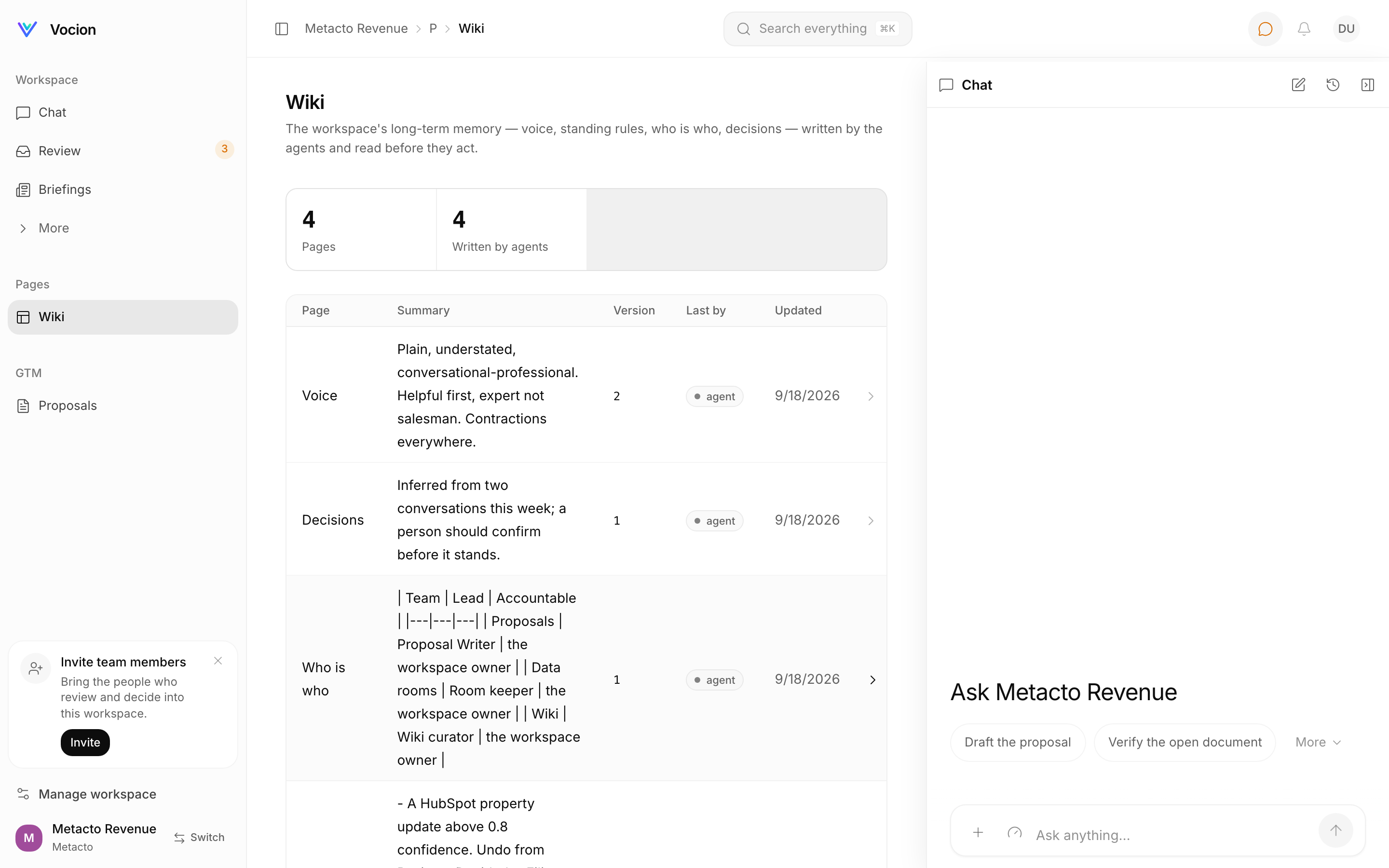
Agents have two kinds of memory in Vocion already. Learnings are fast: one rule per step, adopted from a correction, mounted into the prompt. A data room's rules and notes are per-client. What was missing was the slow layer — the facts that change over months and have to be true every time: how we sound, what we never promise, who owns what, what we decided in July and did not walk back. Until now an agent asked for those, or guessed.
What a real wiki taught us
Before building one we read a founder's hand-run wiki: nine weeks, forty-odd pages, a dashboard, a daily touch list, a Cloudflare worker syncing state into git. It was built with care and it is a good record of what works.
The pages that carried weight were a handful: the voice page, cited by the skills, the client rooms and the coding assistant's instructions alike; the rules prose on the CRM page, read by two scripts; the StoryBrand message sheet. Pages an agent read before it wrote.
Everything else was written once. The eight founding doctrine pages were committed on one day in July and never touched again. The activity log the README calls "the append-only ledger" has three commits, all from that day. The industry radar page still ends with the paste marker — "Paste radar sweeps below, newest first" — and no sweep was ever pasted. The founder CRM's touch log has exactly one week block. Every ritual that asked a person to copy something from an app and paste it into markdown ran once.
The lesson is not "wikis fail". It is: the wiki is worth exactly the pages an agent reads before acting, and the write path has to be a machine's, never a person's chore.
How the plugin is built
A page is an artifact. Not a new table. A markdown artifact in the wiki folder,
anchored to its slug. That one decision gave the wiki versions, restore, the preview pane,
share and citation without writing any of them (design principle 7: the next kind costs a
descriptor, not a subsystem).
Every agent gets it in context. The index — every page with a one-line summary, its
version, when it changed and who changed it — is mounted at /wiki/index.md on every turn,
with the pages that fit beside it. The system prompt says: read the page before acting on a
standing fact, and cite it. A page that did not fit is one read_wiki_page away.
The writer is the agent, with a bar. write_wiki_page takes the page (whole, or a dated
section appended to a running page like Decisions), a reason, and a confidence. The write is
a reversible action, so the done-for-you ladder decides: above the plugin's bar — 0.6, lower
than the platform's 0.8 because a wiki edit is cheap to undo — the page is written at once and
shows in Review › Decided with Undo; below it, a card carries the page and the reason and a
person decides.
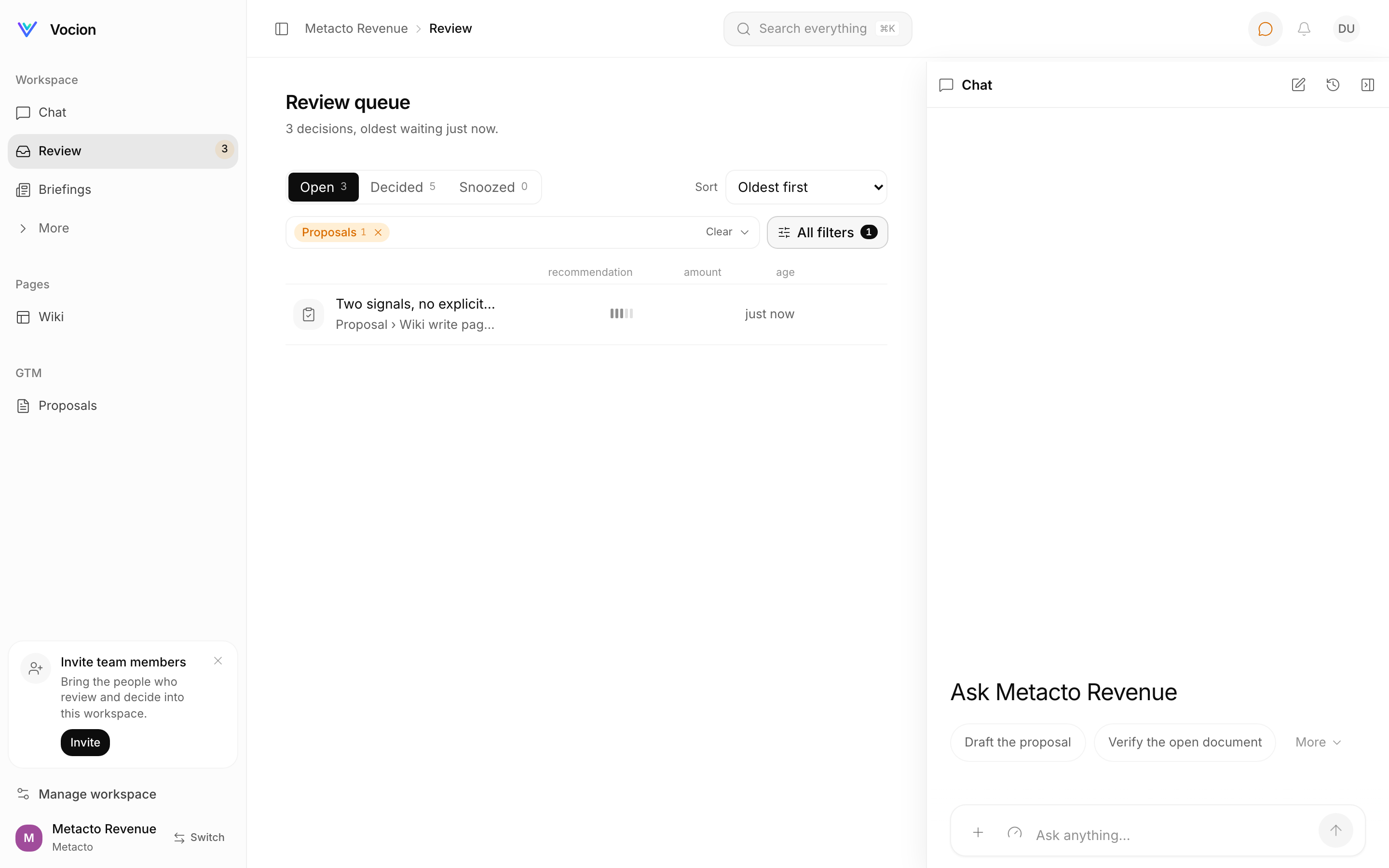
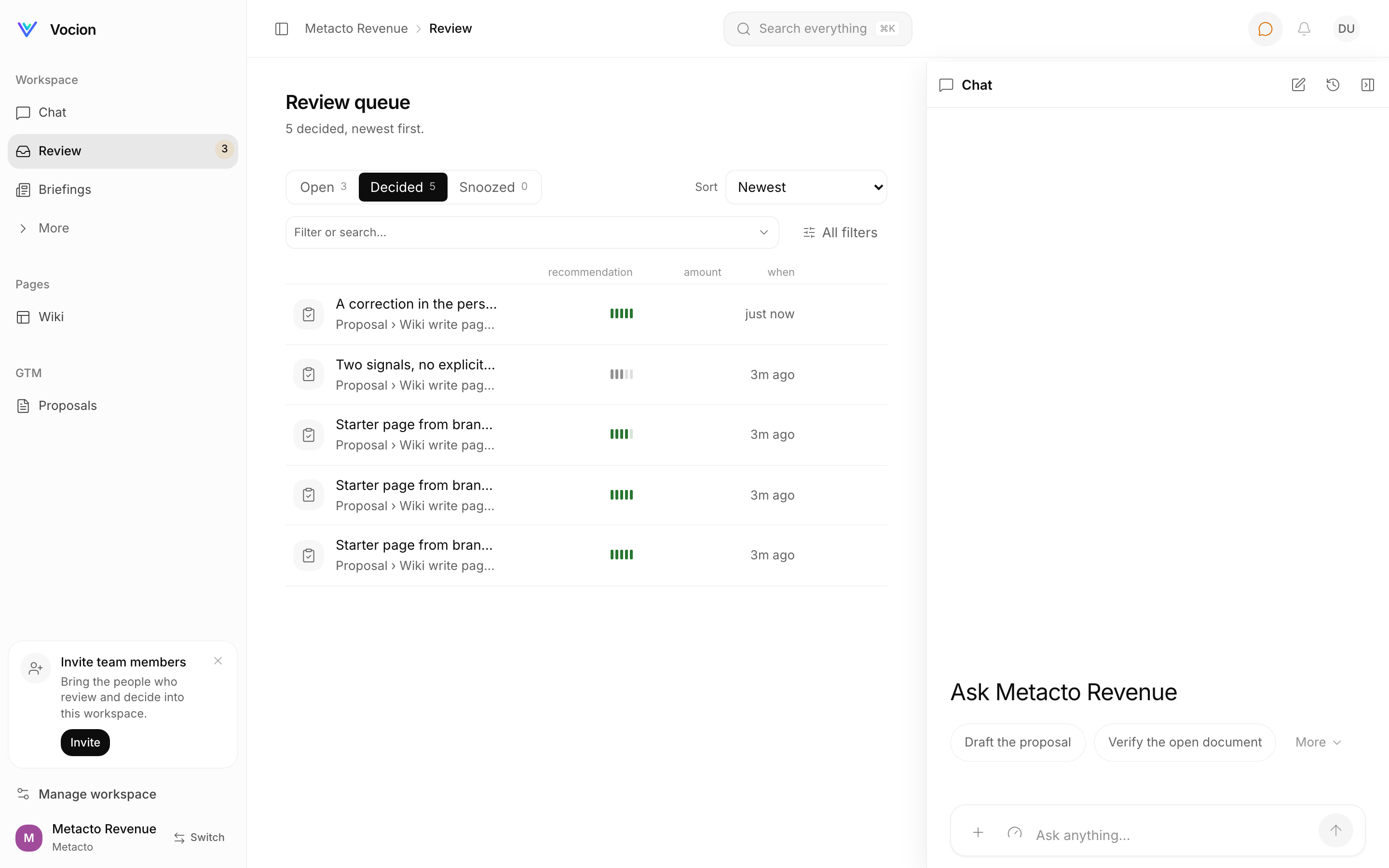
Building this exposed a gap. Every action Vocion had registered until now touched the outside world — an email, a CRM field — so the permission gate and the confidence bar always agreed. The wiki write is internal, the permission gate said "within autonomy", and a 0.45-confidence write ran past the 0.6 bar. The fix is now a rule: an agent's proposal that carries a confidence is always judged by the ladder. Autonomy alone never releases it.
Every save indexes for search. An artifact.saved event fires on every save, the plugin's
wiki-index automation runs the index-artifact job, and search_knowledge finds a wiki page
like any connected document. Both pieces are generic — any plugin can index a folder the same
way.
A curator keeps it true, small and read. Every Friday the Wiki curator reads the week's learnings, decided review items, data-room notes and corrections, decides what became a standing fact, writes it to the right page with an honest confidence, merges pages that say one thing, and proposes removing what nobody read. On an empty wiki it starts four pages from what the workspace already knows — the brand voice, the trust rules, the team, a dated first decision — and then stops. The wiki grows through use.
It is measured. The plugin's team is graded on pages that exist, pages the curator wrote this week, and edits a person had to decide. The last one is the trust signal: the fewer, the more the workspace trusts its wiki.
What it looked like on the first live run
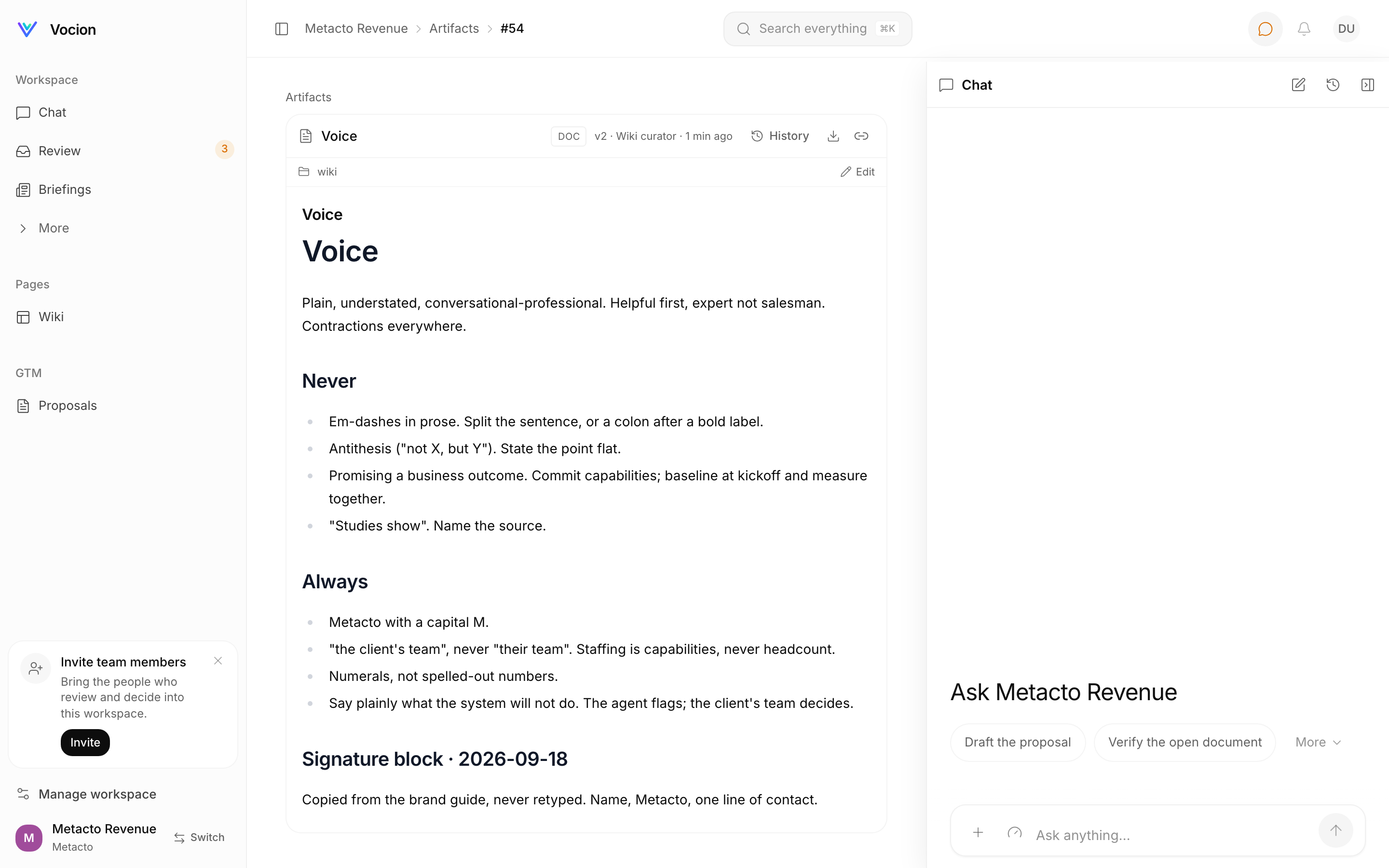
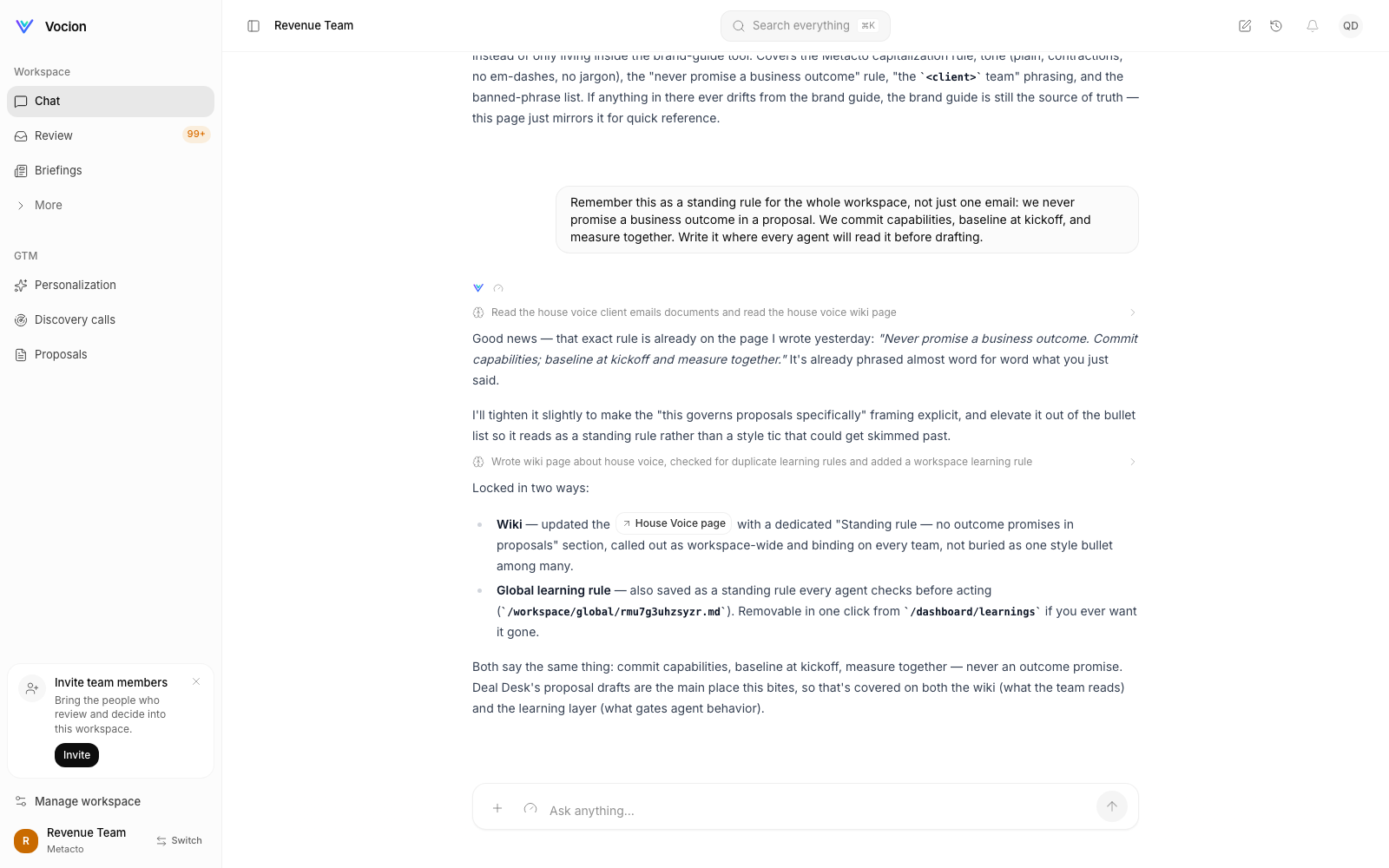
On the first production turn the workspace lead listed the wiki (empty), read the brand guide, and wrote the house voice as a page on its own — above the bar, so it landed at once with a chip in the reply. Asked a minute later to make "never promise a business outcome" a standing rule, it revised the page to a version 2 and saved the same rule as a learning, and said which layer each one governs.
Using it
Turn it on: plugins: [wiki], or the Marketplace, or say yes when the chat recommends it —
it will, when you repeat a standing fact you have said before, or ask where something is
written down.
Then talk. "We write the client's team, never their team" becomes an edit to Voice. "Remember: internal calls file in the wiki, client calls in the room" becomes a standing rule. "We decided to price per opening" becomes a dated section under Decisions. When an agent relies on a page, it cites it, and the claim is one move from its source.