One job. Many agents. One record.
How Vocion keeps business outcomes traceable across delegated tasks, retries and changing evidence without counting the same work twice.
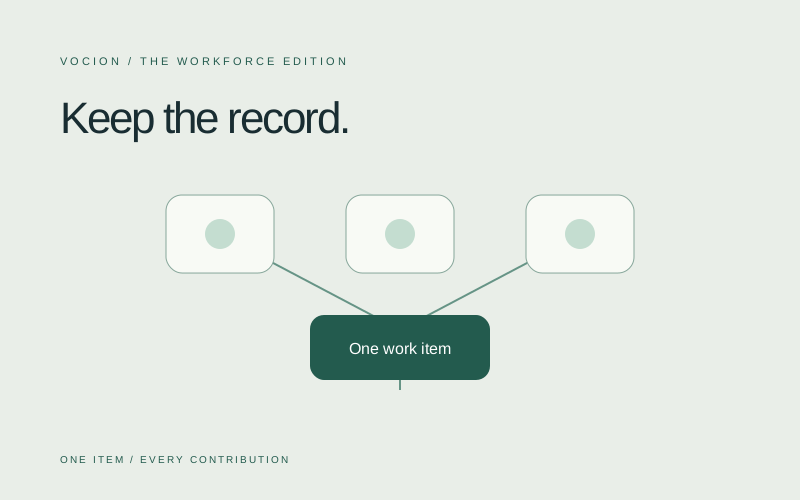
A team of agents can produce dozens of model calls while preparing a single briefing. If the first run fails and the second succeeds, a run counter grows again. The business still asked for one briefing.
That difference matters as soon as you want to measure throughput, quality or cost. Vocion's workforce outcome record gives the business item an identity of its own, independent of execution attempts.
Start with the thing the business asked for
An explicitly registered work item has a business key scoped to its workspace. Registration captures the workflow type, accountable agent or team, configuration version and acceptance criteria. A manual baseline can be included with its source, whether it is assumed or measured, and its timed sample size.
Action proposals, worker attempts and native mission runs can then be linked to that item. The same source record cannot be attributed to multiple items. A retry adds evidence to the original item rather than manufacturing another business outcome.
This is explicit linkage. It is not a claim that every existing workflow is automatically instrumented.
Preserve what happened across the team
A mission link preserves the task graph, task owners, execution status, configuration version and recorded mission model cost. Assigned agents and agents observed in model-call records are distinct: being named in a plan is not evidence that an agent actually contributed.
An operator can follow the source link into the native run. The work record retains the relationship between that execution and the requested outcome. Scheduled work follows the same principle: each scheduled occurrence is its own business item; a retry of that occurrence belongs to it.
Make acceptance refer to specific evidence
A human review is meaningful only if you know what was reviewed. Source fingerprints identify the linked evidence. If the source changes, an earlier attachment needs refreshing. Changes after acceptance flag the old outcome and remove it from current accepted totals until the evidence is refreshed and reviewed again.
Review is a human attestation, not an independent proof of correctness. API tokens can register and link work, but they cannot impersonate a human review.
Commands use workspace-scoped idempotency keys and expected revisions. Identical retries return the original receipt. Conflicting payloads, stale revisions and cross-workspace references are rejected. Terminal outcomes require an explicit reopen before changing.
Keep the economics honest
Mission model cost and worker cost can cover overlapping execution. The interface keeps them separate. Missing costs remain unknown. A baseline multiplied by an item count is not enough to establish net savings: review, corrections, exceptions and scope differences matter too.
The exported snapshot provides durable evidence for reconciliation. It is not an acknowledgment that a central analytics system received the data, and the reporting cohort is items updated within the selected window—not every eligible business task.
These distinctions make the record useful beyond a demo. Leaders can ask what was accepted. Operators can inspect the attempts. Engineers can explain exactly what the system counted.
Implementation
See the mission evidence implementation and workforce measurement contract. The release was checked against live adversarial cases covering tenant isolation, conflicting retries, stale revisions and concurrent decisions. Those checks validate the exercised paths; they are not a blanket security certification.
For the product view, read See what your agents actually accomplish.